
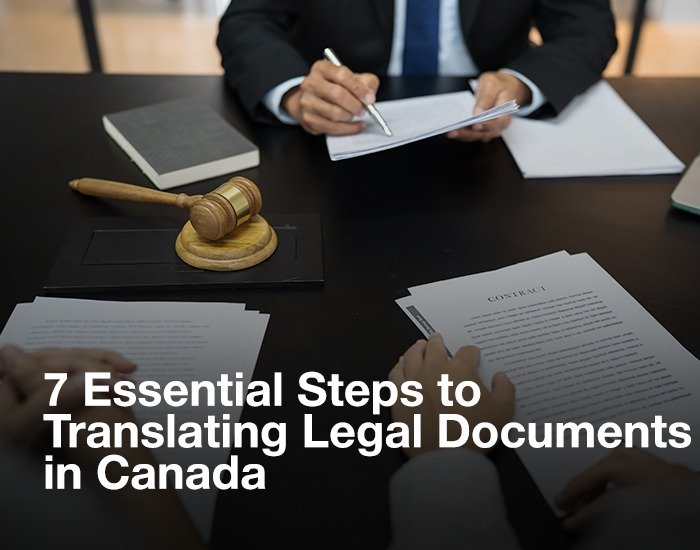
Translating legal documents is a very complex task that requires accuracy, legal specialization, and a good command of both the language of the document as well as the language into which it will be translated. Validated translation for legal content helps to avoid many pitfalls and thus facilitates business, immigration, legal action, etc.
Follow this guide to the 7 essential steps while translate legal documents in Canada.
- Understand the Purpose of Translation
The first in the administrative framework is making sense of the document which the client wants to be translated. Be it for making an application in a court of law, for immigration purposes or for making a business plan the extent of detail and precision required will be different. The document type therefore does not mean the same range for privacy contracts. Stating the specific purpose of the document helps the translator select the most appropriate language concerning legal terms so that the legal translation of documents achieves the target quality of the specific documents in question.
- Hire a Certified Legal Translator
Legal document translation in Canada would not be complete without hiring a certified translator. An experienced translation expert in legal matters basically oversees the cohesion and flow of tax documents, agreements, lawsuit citations and other legal entities. Such certified translators are required to assist in the execution of legal actions such as immigration, contracts or other coercive actions stemming from a court, therefore making their presence in practice especially during translations mandatory.
- Assemble the First Drafts
The translation work can only begin when the original legal documents have been sourced. Ensure they are filled out properly and are free from errors. Contracts, affidavits, certificates and the rest of the originals that are legally translated are easy to produce. If the source material includes false statements, or inaccuracies, then translation can and will suffer, leading to potential problems with any authority that accepts the documentation.
- Check the Qualifications of the Translator
Legal documents usually include lots of complex terms and phrases. It is necessary that the translator has sufficient legal knowledge in his or her language and the language of the original text. This makes certain that a specific aspect of the document is not lost as it is being translated. For instance, even Canadian law might require legal terms to be translated using different systems in other countries, which might cause some distortion of the original concept.
- Review the Work Very Carefully
Legal documents do require quality control when translating them. To prevent any errors, the translated document has to be edited and checked at all costs. At times, the document is followed closely and some cases might require a second set of eyes on the document. This is a rather important process as legal documents need to be accurate and all errors, even the smallest, can change the repercussions in court.
- Certification and Notary
The need for the notarization of a translated legal document does seem common across jurists in Canada. In this case, the need for certification might arise to facilitate easy acceptance of the document by other courts or even outside Canada. If one is speaking specifically in the case of an appeal, court documents would probably come first to mind. Having litigation papers certified affirms from the outset that there will not be any standard errors made in court. One should invariably check all the requirements of the institution receiving the documents to cut the risk of rejection to zero.
- Filing with the Proper Offices
The last step after a document has been accurately translated as required and certified is to file it with the right offices, for instance, these may include immigration or the courts or even business. In all departments concerning documentation to be presented, it is important to take note of the set standards in those institutions. A single word for a description might suffice to illuminate the situation, the legal field is greatly swathed in specificities, and any deviation might trigger rejection.
The Value of Helpline Group’s Legal Services
Helpline Group will help you translate any legal document that needs to be submitted in Canada. You can contact Helpline Group for certified legal translation services as we have years of experience and understand the complexity involved in legal translation.
For effective legal translation in Canada, contact Helpline Group now.

Recent Comments